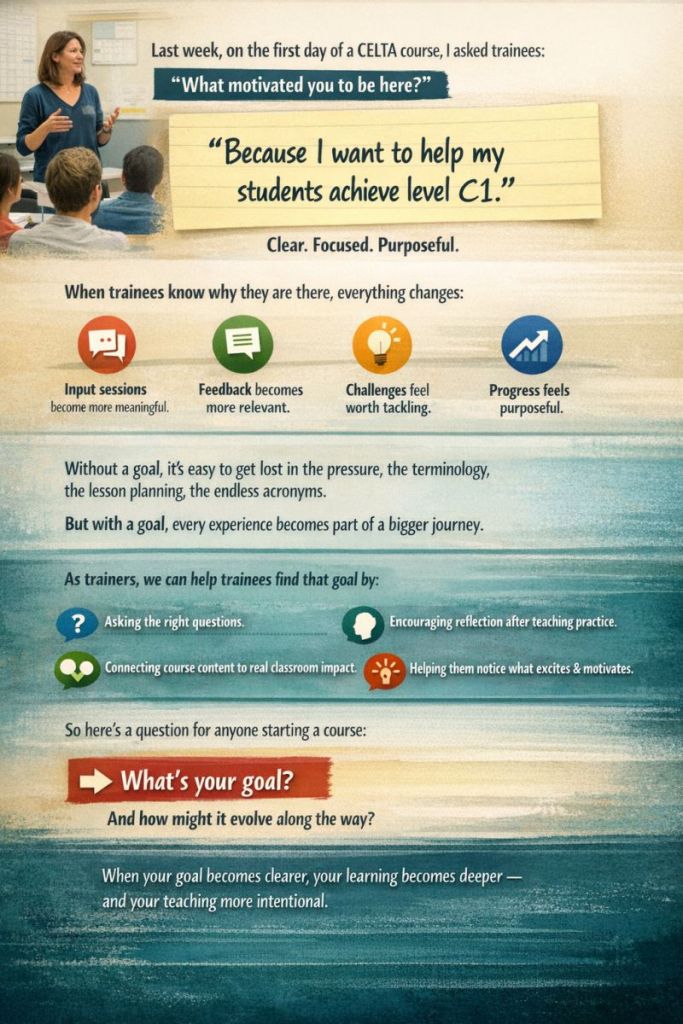
Last week, on day one of a CELTA course, I asked the usual opening question:
“What brought you here?”
I’ve heard the standard replies more times than I can count. Career shifts. A love of languages. Plans to travel. The need for a qualification. All fair enough.
Then one trainee said, “I want to help my students reach C1.”
That landed differently. No talk about themselves, no mention of the course. Just learners, and a very specific outcome.
It raised the stakes straight away.
There’s something about that kind of clarity. It sharpens attention. It gives weight to what might otherwise feel like just another input session or another round of feedback. Instead of absorbing ideas in the abstract, you start testing everything against a question: will this actually move my learners forward?
CELTA can easily blur into survival mode. New terminology, unfamiliar frameworks, lesson planning that never quite feels finished, teaching under pressure, feedback that can sting. Without a clear sense of purpose, it’s tempting to focus on getting through it rather than making sense of it.
But when there’s a goal, even a rough one, things begin to line up. Input becomes usable. Feedback starts to point somewhere. The difficult moments feel less arbitrary. Progress becomes easier to spot because it connects to something real.
That said, most trainees don’t arrive with that level of focus. Many start with something vague or external. A job requirement. A possible career move. A bit of curiosity. That’s not a problem. It just means the goal hasn’t taken shape yet.
This is where training matters. Not in handing people a purpose, but in helping them notice one.
It often starts in small ways. Asking what actually worked in a lesson and for whom. Pushing beyond “Was that clear?” to “What did students do differently because of it?” Drawing a line between what happens on the course and what will happen in their own classrooms. Paying attention to what energises them, or what keeps frustrating them.
Over time, something shifts. “I just need the certificate” turns into “I want my quieter students to speak more,” or “I need to get better at setting up tasks.” Not polished, but real.
Even that C1 goal will probably change. It might become more precise, more grounded in actual learners. Maybe it narrows to helping B2 students make the jump. Maybe it turns into a focus on task design, or on why some learners stall at higher levels. The direction stays, but the understanding deepens.
So the question is worth keeping alive beyond day one:
What are you actually working towards now?
Not as a box to tick, but as something that keeps shifting as you learn.
Because once that sense of purpose settles in, teaching stops feeling like a collection of techniques. It starts to hold together.
That one answer stuck with me for a reason. It was a reminder that clarity isn’t just helpful. It changes how everything else is read.
 Connect English
Leave a comment