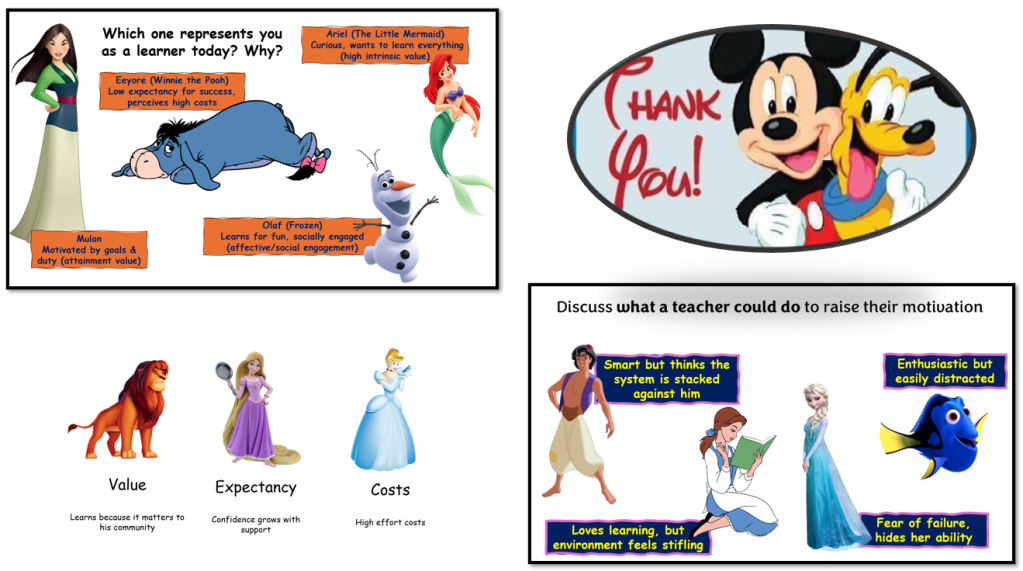
On the same day I delivered a session on professional development and talked about change – a topic deeply inspired by Rachel’s thought-provoking ideas – I also had the pleasure of running a session on learner motivation. This session, however, took a more playful and imaginative turn: I decided to bring Disney characters into the classroom.
Using familiar figures such as Ariel (The Little Mermaid), Simba (The Lion King), and Elsa (Frozen), I aimed to illustrate different types of motivation and the factors that drive learners to engage – or disengage – with language learning. What began as a creative experiment quickly became one of the most dynamic and enjoyable sessions of the course.
Why Disney?
Disney characters are rich in symbolism and universally relatable. They embody dreams, fears, perseverance, and transformation – much like the emotional journey learners experience when studying a new language. As Dörnyei (2001) highlights, motivation is not a fixed trait but a dynamic process influenced by both internal and external factors. By connecting theory to recognizable characters, abstract concepts such as intrinsic and extrinsic motivation became instantly more tangible.
For example, we discussed how Ariel’s motivation to learn about the human world mirrored integrative motivation (Gardner, 1985) – a desire to connect with another culture. Simba, on the other hand, represented amotivation and regained motivation, reflecting a learner who temporarily loses purpose but rediscovers it through support and self-belief. These parallels sparked laughter, empathy, and deep reflection among trainees, who could easily link these fictional journeys to their students’ real experiences.
Engagement and emotional connection
The session’s success lay in how it tapped into emotion as a pedagogical tool. As Arnold and Brown (1999) argue, emotion plays a key role in language learning; when learners (and teachers-in-training) feel emotionally connected to the content, engagement and retention increase.
By incorporating Disney characters, the trainees didn’t just learn about motivation – they felt it. Many commented that they saw parts of their students, and even themselves, in these characters. The activity created a safe space for humor, self-awareness, and reflection. It reminded everyone that motivation is personal, contextual, and sometimes unpredictable, just like the characters’ journeys.
Bringing theory to life
From a methodological standpoint, the session aligned with experiential learning principles (Kolb, 1984). Trainees didn’t passively absorb theory; they experienced it through stories, discussion, and collaborative reflection. The use of familiar pop culture references made theoretical concepts like Dörnyei’s L2 Motivational Self System (2005) accessible and memorable.
This approach also echoed Harmer’s (2015) emphasis on making learning relevant and meaningful. When trainees can connect their learning to something they care about, or even smile about, they are more likely to internalize it and apply it in their own classrooms.
Reflections
Looking back, using Disney as a lens to explore learner motivation felt not only effective but joyful. It transformed what could have been a theoretical session into a vibrant, reflective experience. Trainees left the room inspired, some even brainstorming how to use storytelling, film, and characters to motivate their own learners.
Motivation, after all, is about more than techniques, it’s about connection, imagination, and belief in change. And sometimes, a little Disney magic helps us see that more clearly.
References
- Arnold, J., & Brown, H. D. (1999). Affect in Language Learning. Cambridge University Press.
- Dörnyei, Z. (2001). Teaching and Researching Motivation. Pearson Education.
- Dörnyei, Z. (2005). The Psychology of the Language Learner: Individual Differences in Second Language Acquisition. Lawrence Erlbaum Associates.
- Gardner, R. C. (1985). Social Psychology and Second Language Learning: The Role of Attitudes and Motivation. Edward Arnold.
- Harmer, J. (2015). The Practice of English Language Teaching (5th ed.). Pearson Education.
- Kolb, D. A. (1984). Experiential Learning: Experience as the Source of Learning and Development. Prentice Hall.


Leave a Reply