One of the questions I hear most often from CELTA trainees is, “Where do I start?” It usually comes a few days before their first teaching practice, when they’re staring at a blank lesson plan, a coursebook, and far too many tabs open in their browser.
Many trainees instinctively begin by creating PowerPoint slides, searching for pictures, or adapting worksheets. There’s nothing wrong with any of those things, but they’re not the best place to start. In fact, spending too much time on materials before you’ve worked out what learners actually need to learn can make planning much harder.
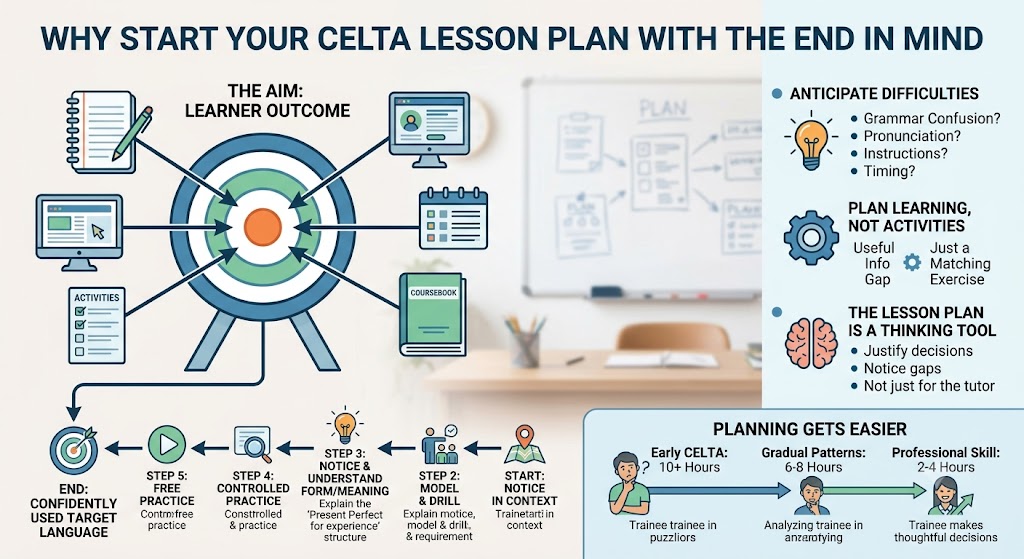
The first question you should ask yourself is a much simpler one: What do I want my learners to be able to do by the end of this lesson that they can’t do confidently now?
Once you have a clear answer, the rest of the planning process becomes much more straightforward.
Start with the destination
I often tell trainees that lesson planning is a bit like planning a journey. You wouldn’t decide which roads to take before knowing where you’re going. The same applies to teaching.
Your lesson aim gives you a destination. Every stage, every activity and every question you ask should help learners move a little closer to that destination. If an activity doesn’t contribute to the lesson aim, it’s worth asking whether it really belongs in the lesson at all.
This doesn’t mean every lesson follows exactly the same pattern, but it does mean that every stage should have a clear purpose. Learners should never feel as though they’re simply completing a series of unrelated tasks.
Think about learning before activities
One of the biggest changes I see during CELTA is the shift from planning activities to planning learning.
Instead of asking, “What should I do next?”, try asking, “What do my learners need next?”
The difference may seem subtle, but it changes everything.
Imagine you’re teaching the present perfect for experiences. Before learners can use the language confidently in a discussion, they’ll probably need to notice it in context, understand its meaning, analyse how it’s formed, practise saying it accurately, complete some controlled practice, and only then move on to freer communication.
Notice that the lesson develops because of what learners need, not because a coursebook happens to contain a sequence of exercises.
Anticipate what might happen
A lesson plan isn’t simply a list of procedures. It’s also an opportunity to think ahead.
Which language point is likely to cause confusion? Which pronunciation feature might learners struggle with? Could the instructions be misunderstood? Is there enough support before asking learners to complete a task independently?
Experienced teachers ask themselves these questions almost automatically. That’s not because they’re better teachers; it’s because they’ve learnt to anticipate what might happen in the classroom.
During CELTA, developing that habit is just as important as learning how to write aims or stage procedures.
Remember that learners matter more than the plan
One mistake many trainees make is becoming too attached to their timings. They write “5 minutes” or “8 minutes” on the lesson plan and then feel they’ve failed if a stage takes longer.
The timings are there to help you manage the lesson, not to dictate it.
If learners are engaged, asking thoughtful questions and making genuine progress, spending an extra couple of minutes on a stage is often worthwhile. Equally, if a task clearly isn’t working, there’s no prize for sticking with it simply because the lesson plan says you should.
Good teaching requires flexibility. Your lesson plan should support your decisions in the classroom rather than limit them.
Your lesson plan is for you
Another misconception I often hear is that lesson plans are written for the tutor.
Of course, your tutor will read them and give you feedback, but that’s only part of the story.
The real purpose of a lesson plan is to organise your own thinking. It encourages you to justify your choices, identify potential problems before they arise and think carefully about how one stage leads naturally into the next.
Whenever I read a strong lesson plan, what stands out isn’t the formatting or the length. It’s the clarity of thought behind it. Every stage has a purpose. Every activity contributes to the lesson aim. Nothing is included simply because it seems like a good idea.
It gets easier
Planning your first CELTA lesson can easily take ten or twelve hours. Sometimes even longer. Most trainees are surprised by how mentally demanding it is.
That’s completely normal.
You’re learning to think like a teacher rather than simply preparing a lesson.
As the course progresses, you’ll begin to notice recurring patterns. You’ll become quicker at identifying likely learner problems, clearer when writing instructions and more confident deciding how much practice learners need before moving on.
Eventually, lesson planning stops feeling like completing a template and starts feeling like professional decision-making.
And perhaps that’s the most important lesson CELTA teaches. It’s not about producing perfect lesson plans or delivering flawless lessons. It’s about learning to make thoughtful, informed decisions that give learners the best possible chance of succeeding.
That’s a skill you’ll continue to develop long after the CELTA certificate has been framed and put on the wall.
 Connect English
Leave a comment