Every time I start a new CELTA course, there is a moment I look forward to: the demo lesson. It is usually one of the first opportunities trainees have to see their trainer actually teach. They get to experience a lesson as learners rather than as observers, and later we can unpack what happened: the aims, the staging, the instructions, the interaction patterns, the materials and, perhaps most importantly, the teacher’s decisions.
Traditionally, I would use a lesson from the coursebook the trainees were going to work with during the course. This time, I decided to do something different. I asked the trainees to send me a short passage introducing themselves, saying something about who they are and why they had decided to become teachers, change careers or start a new career. I also asked them to send me a picture. I then took that information and used it to create my demo lesson.
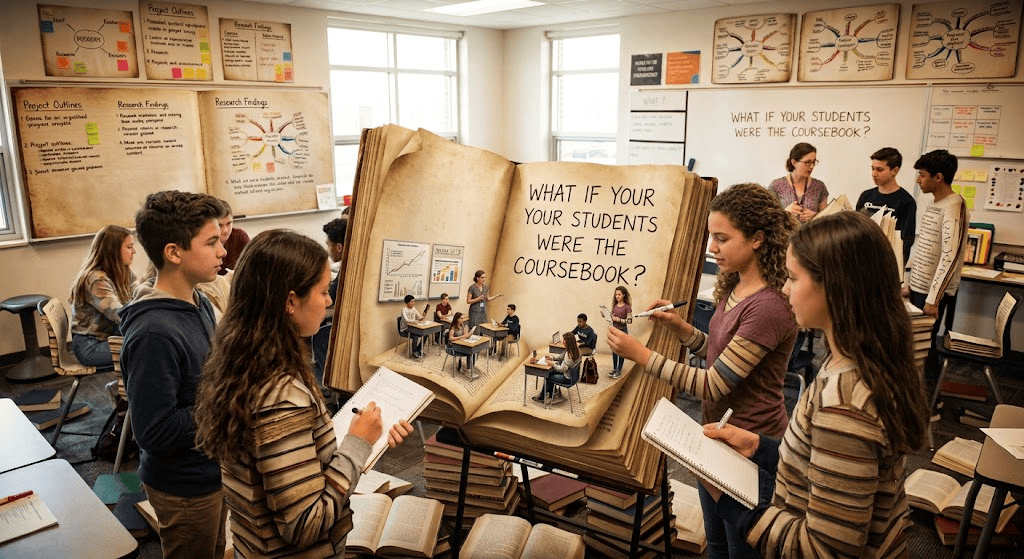
Not from a coursebook. From them.
The trainees became the material
The lesson I am going to teach is a reading skills lesson, so their photographs and short introductions will become the material for the reading tasks. But the principle isn’t really about reading. I could have used exactly the same information to create a listening lesson, a speaking lesson, or a language lesson focusing on vocabulary or grammar. The important thing is not the skill or language system being taught. It is the decision to use the people in the room as a source of material.
There is something rather satisfying about this. Before the trainees have taught a single lesson on the course, they are already learning something about the people they are going to be teaching during their teaching practice. At the same time, I get to know more about the trainees themselves. A group of trainee teachers is not simply a collection of people who happen to have enrolled on the same qualification. They arrive with different experiences, expectations, personalities, professional backgrounds and reasons for being there. Those differences are part of the learning context, and the more I know about that context, the more possibilities I have when I plan.
There is another benefit too. By using the trainees’ own stories and photographs, I am beginning to introduce them to the TP students before they start teaching. The students get to find out who these new teachers are, while the trainees get to see the learners they will soon be working with. In a small way, the demo lesson starts bringing the two groups together before the teaching practice begins.
More than personalisation
At first glance, this might simply look like an example of personalised learning. It is certainly more personal than opening a coursebook at a random page, but I think there is something else going on here: belonging.
The trainees are not just sitting through a demonstration of what a CELTA lesson looks like. They are seeing themselves and their colleagues represented in the lesson. Someone might recognise a place in another trainee’s photograph. Someone might discover that another person has also changed careers. Someone might become curious about why a colleague decided to become a teacher. The lesson gives them reasons to find out more about each other.
The same thing can happen in a regular language classroom. When we use our students’ experiences, interests, ideas and knowledge as part of what happens in the lesson, we are sending a fairly simple message: you are part of this classroom, and what you bring with you has a place here. That can help create a stronger sense of belonging. It can also make the teacher feel closer to the students because we are no longer teaching an anonymous group. We are teaching people whose lives, interests and experiences we know something about.
This doesn’t mean turning every lesson into a conversation about the students or trying to make everything entertaining. Personalisation is not a substitute for good teaching. A student’s favourite TV programme does not automatically make a good lesson, and knowing that several students support the same football team does not give us a lesson aim. We still need to think carefully about what learners need to do, what they need to learn and how the activities will help them get there.
The personal connection is the starting point, not the lesson plan.
This is actually very CELTA
There is a slightly ironic thing about this. A demo lesson based on trainee-generated material might look like I am doing something quite different from a conventional CELTA lesson, but it allows me to model several things trainees are expected to develop throughout the course.
The Cambridge CELTA syllabus explicitly includes teaching with an awareness of learners’ needs and interests, learning preferences, cultural factors, backgrounds and previous learning experiences. It also expects trainees to select, adapt or design materials and resources that are appropriate for their lesson aims. Cambridge English CELTA syllabus
So “knowing your learners” isn’t just a nice extra that we do when we have time. It is part of the job. The syllabus also places emphasis on rapport and learner involvement, which makes this approach particularly relevant to a demo lesson. I am not simply trying to make the lesson more interesting for the trainees. I am modelling a particular way of thinking about planning: Who are my learners, and what can I do with what I know about them?
That question can lead us somewhere quite different from simply asking, What page am I teaching today?
You don’t need to be a CELTA trainer
At this point, you might be thinking, “That’s all very well, but you’re a CELTA trainer. I’m not a teacher trainer. How can I do that?”
You don’t need to be a teacher trainer. You just need to know something about your students.
Maybe you know that several of them live in the same part of the city. Maybe a few are obsessed with a particular TV series. Perhaps one student has just started a new job, another has recently moved house, or someone has told you an interesting story about a holiday. Maybe they all have strong opinions about public transport, or half the class loves football while the other half couldn’t care less. Perhaps you’ve discovered that they all have different reasons for learning English.
These things can become material. A lesson about travel could start with places your students have actually travelled to. A lesson on describing people could use photographs they have chosen themselves. A lesson on past experiences could draw on something they have told you about their lives. A lesson about places in a city could use the neighbourhood where they live. A speaking lesson could begin with a question that came out of a conversation you had with the class the previous week.
None of this means abandoning the coursebook. The coursebook is still a valuable resource. The point is to recognise that it is one source of material, not the source of all our lessons.
From “What should I teach?” to “Who am I teaching?”
When planning a lesson, it is very easy to start with the material. We look at the page and think, “Today we’re doing the present perfect,” or “Today we’re doing a reading about working from home.” We then work out what we can do with the material in front of us.
There is another way into planning, though. We can start with the people: Who are these learners? What do I know about them? What might they find interesting? What experiences do they already have? What could they bring to this lesson?
That shift is closely connected to the idea of learner-centredness. Learner-centred teaching is not simply about putting students into pairs and making sure the teacher talks less. It involves taking learners’ needs, experiences and interests into account and creating opportunities for them to participate meaningfully. Research into personalised learning also provides evidence that connecting learning with learners’ interests can support interest and engagement, although personalisation is certainly not a magic formula for participation.
There is a relational dimension to this as well. Knowing our students gives us more opportunities to build rapport. We remember things they have told us. We can follow up on previous conversations. We can use their ideas as examples. We can show that what they contribute doesn’t disappear as soon as the lesson ends. Over time, these small moments can help students feel more visible in the classroom, and feeling visible can be part of feeling that you belong.
There is another lesson hidden inside my demo lesson
For me, this is perhaps the most useful part for the CELTA trainees. They aren’t just experiencing a lesson. They are experiencing a way of creating a lesson.
I want them to see that a lesson can begin with a page in a coursebook, but it doesn’t have to. It can begin with a photograph, a conversation, a text message, a map, a question, a local event, a shared experience, a disagreement, a story, a mistake someone made or a question someone asked yesterday. In this case, it begins with a few paragraphs written by a group of trainee teachers who haven’t even started their teaching practice yet.
The material itself isn’t necessarily the clever part. The planning decisions that come afterwards are. What can I ask learners to do with this? What can they predict, discuss, compare or infer? What language can they notice? What could they learn from each other? How can I turn this into meaningful language practice rather than simply talking about something interesting?
That last question matters. Personalised material isn’t automatically a good lesson. We still need clear aims, appropriate staging, useful tasks, meaningful interaction and a reason for learners to use language. The fact that something is personal does not make it pedagogically effective. What makes it useful is what we do with it.
So, what do I know about my students?
That’s probably the question I’m going to take into this CELTA course.
Not simply, What does the coursebook say I should teach? But What do I know about the people in front of me? And what can I do with that?
This doesn’t require hours of research or an elaborate personalised learning platform. It can start very simply. Ask your students a question. Listen to their answers. Notice what they talk about. Find out what they already know. Pay attention to the things that make them laugh, disagree, explain, remember or ask another question. Keep a few of those things in the back of your mind when you plan.
You might discover that your next lesson is already sitting there.
You just hadn’t realised it was teaching material yet.
And perhaps that’s the real point of this demo lesson. I’m not just showing my trainees that we can teach a reading lesson without opening the coursebook. I’m showing them that the people in the room can be part of the lesson too. That can make the lesson more meaningful, give learners something genuine to contribute, bring people closer together, boost engagement and help create a classroom where people feel that they belong.


Leave a comment